An emergency power plant is bought for what it does the day the grid fails, but it is judged by what it does on the other three hundred and sixty-four: being ready. The equipment is the easy part. What decides whether the backup works is the substation feeding it, the transfer switch calling it, and the installation connecting it.
What we did
Supply, rigging and installation of the full backup assembly: substation with a pad-mounted transformer, medium-voltage cells and switchgear, transfer and protection panels, and the generator set.
How it was executed
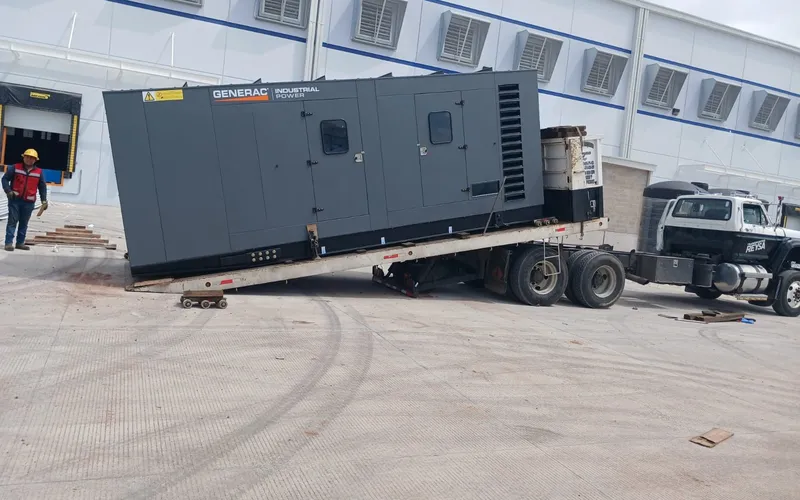
Rigging. The generator set arrives on a flatbed and has to be unloaded, moved and set in its final position. It is the most visible part and the one with the least margin for error: you do not lift that equipment twice for fun. The pad has to be poured, level, and with the electrical provisions already in place before the crane reaches the site.
Medium voltage. The terminations on the transformer bushings are the fine work of this project. Medium voltage does not forgive improvisation: it demands dielectric clearances that are respected, correctly selected primary protection, and rigging by authorized personnel with protective equipment rated for arc flash.
Transfer and control. The transfer switchgear is what decides, automatically, when the generator picks up the load and when it hands it back to the grid. It was installed, wired and left operating alongside the generator’s control panel.
The result
The substation room with its cells lined up, the control panel labeled circuit by circuit, and the generator set connected and in position. A backup that gets tested, not assumed.