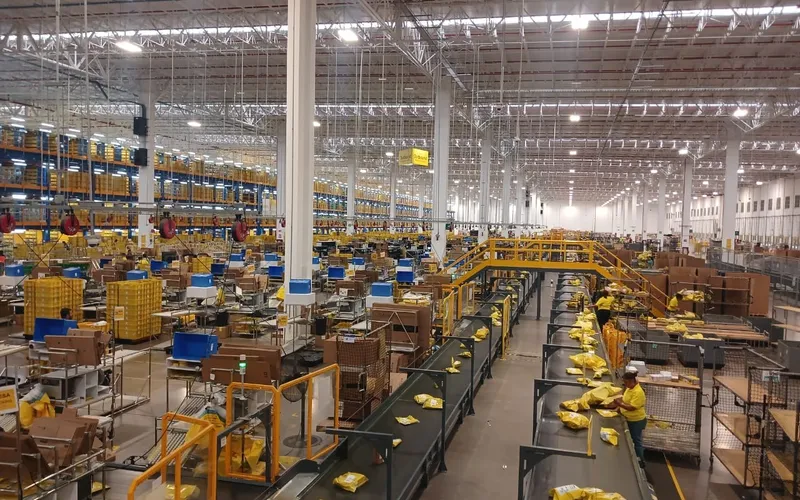
An industrial electrical installation gets designed twice: once on paper and once, unintentionally, on site. The distance between the two is the project’s cost overrun. When the calculations are done, and done properly, construction is almost mechanical; when it is improvised, every decision left open ends up being settled with demolition, rework and equipment already purchased that turns out not to be the equipment you needed. We handle both halves — the design and the build — because the seam between them is usually exactly where the money is lost.
We design, execute and commission industrial and residential electrical installations in medium and low voltage: from the service entrance and the substation down to the last branch circuit. We have been doing it for ten years, building across Mexico from our bases in Pachuca, Guadalajara and León, and our clients include Conagua and Mercado Libre.
What we solve
The typical scope runs from the service entrance inward: substation (transformer, medium-voltage switchgear, primary protection and metering), main switchboard, low-voltage distribution, motor control centers, conduit and cable tray, industrial lighting, feeds to machinery and variable frequency drives, emergency systems with transfer switching, grounding grid and surge protection. In an existing plant the job is usually a different one: expanding installed capacity, modernizing switchgear that no longer has spare parts behind it, or simply surveying what is actually installed — because in facilities that grew piece by piece, almost nobody has drawings that match reality.
In residential work the problem is the same at another scale — size it, protect it, ground it properly — and it is solved with the same criteria, without oversizing out of habit.
How we work
Site survey. We measure on site: capacity and condition of the service entrance and the transformer, space available for maneuvering, viable routes for conduit, the state of existing panels and protective devices. Out of that comes the load schedule: which equipment, what power, what demand factor and what real simultaneity it has. If the client has not yet settled on machinery, we leave explicit, documented spare capacity rather than a silent assumption; silent assumptions are what later force you to replace the transformer.
Calculations and executive design. This is where the decisions that fix the cost — and the behavior of the installation for the next twenty years — actually get made. We determine maximum demand, choose the voltage level, size the transformer and calculate conductors both by ampacity, with its temperature and bundling correction factors, and by voltage drop. That second condition is the one that governs long runs: the NOM treats it as a recommendation (on the order of 3 % on the branch circuit and 5 % overall), but it is what keeps motors from starting under strain and electronic equipment from rebooting for no visible reason. In parallel we run the short-circuit study, which sets the interrupting capacity of the protective devices, and we coordinate them so that a fault trips the breaker closest to it rather than the main — which would take the whole plant down. The deliverable is an executive design package: single-line diagram, conduit and power drawings, load schedules, technical calculation report and materials specification. Without that package there is nothing to verify, and no honest way to compare two quotes: with no design, each bidder is pricing a different installation.
Construction. Conduit, wiring, substation and switchboard assembly, terminations and grounding grid. Coordination with civil works is what prevents the most damage: embedded ducts, pull boxes, trenches and the transformer pad have to be defined before the concrete is poured, because opening a finished floor to run a pipe costs a multiple of what it cost to leave it in place. Shutdown windows, when the plant cannot stop, are planned during design and not negotiated in the field.
Testing and commissioning. Insulation resistance, ground grid measurement, turns ratio and dielectric withstand testing on the transformer, relay testing, phase sequence verification and torque checks on connections. Then the installation is energized in stages and thermography is run under real load: a switchboard can pass every de-energized test and still hide a loose connection that only reveals itself once current is flowing. We close out with as-built drawings — the installation as it ended up, not as it was drawn — and the full technical file.
Medium and low voltage
Medium voltage is, in practice, anything above 1,000 V; in Mexico distribution typically arrives at 13.8, 23 or 34.5 kV, while the plant works internally in low voltage (480 V for power, 220/127 V for services). As demand grows, at some point it makes sense to take service in medium voltage: the energy itself is cheaper, but in exchange you become the owner of the substation, of its maintenance, and of the obligation to operate it with qualified personnel. That crossover point is calculated from the real consumption profile; it is not a matter of opinion.
Medium voltage also does not forgive improvisation. It demands respected dielectric clearances, surge arresters, correctly selected primary protection, switching by authorized personnel, and personal protective equipment rated for the arc-flash energy present. It is also where power factor lives: below the minimum the tariff requires, the utility penalizes you on the bill, and with a large population of motors or drives, correcting it stops being trivial. A capacitor bank sized without regard for a high harmonic content can hit resonance and destroy itself; the answer there is not more capacitance, it is filtering. Drives, for their part, distort current and heat up the neutral and the transformer: if they represent a significant share of the load, that belongs in the calculations, not in the diagnosis of why the transformer is running hot.
Standards and verification
NOM-001-SEDE governs electrical utilization installations in Mexico. It is not a stamp applied at the end: it is the technical body of rules that dictates conductor sizes, protections, raceways, clearances, grounding and hazardous area classification. Designing outside it and “regularizing” afterward almost always means building it again.
Where the law requires it, compliance is certified through a report issued by an accredited electrical verification unit (UVIE). The obligation is triggered by the cases set out in the conformity assessment procedure — among them medium-voltage installations, large installed loads, classified hazardous areas and places of public assembly — which is to say, in practically any serious industrial project. That report rests on the technical calculation memo and the drawings: if there is no executive design, there is nothing to verify. Better to know this early than when the utility asks for it in order to energize, or when the insurer asks for it after an incident.
On the operations side, NOM-029-STPS governs the maintenance of electrical installations: risk analysis, authorized and trained personnel, lockout/tagout procedures and protective equipment matched to the arc-flash risk. An installation that is well built but operated outside that framework is still a dangerous installation.
Who this is for
For industrial buildings and distribution centers being built from scratch or about to grow; for process plants that need to add load without stopping production; for water infrastructure — sumps, pumping and treatment plants — where the challenge is high-power motors, starting and drives; for data rooms and mission-critical areas that depend on backup and transfer; and for residential projects that call for an installation that was actually calculated rather than copied from the house next door.
And also, frankly, for anyone with an installation that has grown by patches over the years, who does not really know how much load it can take and needs to know before connecting the next machine. That diagnosis is cheap compared with what it costs to find out the hard way.