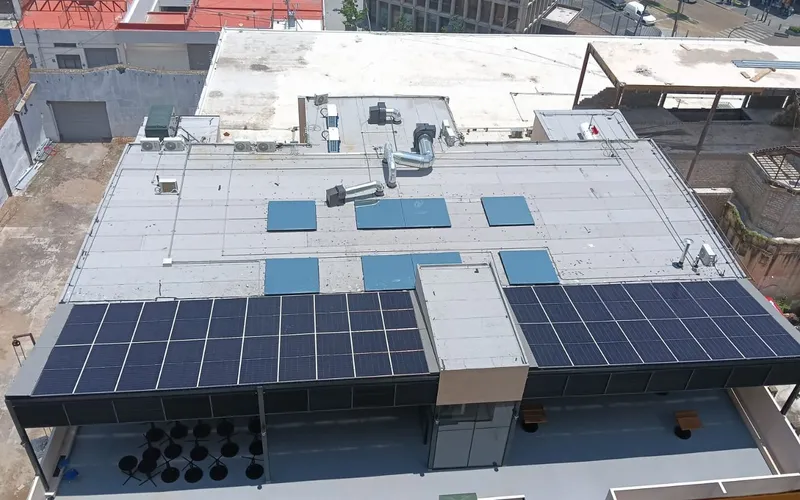
A photovoltaic system is not a catalog product: it is an electrical installation wired into your internal network, subject to NOM-001-SEDE, that will live alongside your operation for decades. At De La Mar we design, install, interconnect and commission photovoltaic systems for industrial plants, commercial buildings and homes. The work begins before the first panel: with your CFE bills, the plant’s single-line diagram and a visit to the roof. That is where the only number that matters comes from —how much energy the system can displace and at what cost— and not the other way around.
What the savings actually depend on
A photovoltaic system does not give you energy: it keeps you from buying it. The savings are therefore not determined by the size of the array, but by the value of each kilowatt-hour you stop buying from CFE. That value depends on your tariff and on the hours in which you consume.
Under time-of-use tariffs, a kWh does not cost the same in the base, intermediate and peak periods. In much of the country the peak period falls after sundown, when the sun is already gone. A plant with a heavy late-afternoon and evening load saves less than a naive calculation over the total consumption on the bill would suggest. On top of that sits the maximum demand charge, billed in kW rather than kWh: solar reduces energy, but it does not guarantee a reduction in billable demand, because a passing cloud or a night-time peak is enough for the meter to record the same demand as always. There are industrial bills where the demand component weighs enough to change the appeal of the project entirely.
The other half of the equation is your daytime consumption profile. The energy you self-consume is worth the full tariff you would otherwise have paid, with all its charges. The surplus you export to the grid is compensated below that value, because it does not include what you pay to transmit and distribute that energy. That asymmetry is the underlying reason why oversizing is throwing money away: every extra panel produces energy you do not consume and that the grid pays you less for. A system that covers your daytime consumption well returns more than one that covers your total consumption and exports half of it.
How we size the system
We size systems from twelve months of bills, not from the size of the roof. Twelve months because your consumption is seasonal —shifts, weather, production cycles— and a single bill will not show it. When the meter records interval data, we work from the hourly load curve, which is what lets us see how much of your energy is genuinely daytime energy and how much is not.
Against that baseline we weigh the available surface, the shading (rooftop equipment, neighboring buildings, trees), the orientation and the tilt. Orientation carries a nuance that is often missed: a west-facing array produces less over the year than a south-facing one, but it produces later in the day, and if your load is concentrated in the afternoon it may displace more expensive energy. We also review your growth plans, because expanding later is possible but rarely free, and both the connection point and the space need to anticipate it.
On the design side, we define the string configuration and the ratio between DC power and inverter capacity. Moderately oversizing the array relative to the inverter is normal and healthy practice; taking it to an extreme clips production during the best hours. The outcome is a proposal with explicit reasoning behind it, not a round number.
Structural review of the roof
Panels are installed on a structure that already exists and was designed without them. Before committing to anything, we check three things.
Dead load: the weight of modules and mounting structure distributed over purlins, joists and trusses, and how it is transferred to the supports. In many plants the margin is there; in others the array has to be reduced or the structure reinforced.
Wind load: this is the critical one on lightweight roofs. Wind does not crush the array, it lifts it, and that suction is not uniform: the edges and corners of the roof work far harder than the center. Fastening type and density, and the setbacks to respect around the perimeter, all follow from this.
Condition of the roof covering: corrosion, seals, existing fasteners and the remaining service life of the sheeting. This is the most common expensive mistake. A photovoltaic system lasts decades; if the roof has only a few years left, someone will have to dismount the array to replace it. If the roof is at the end of its life, the roof gets replaced first.
Interconnection with CFE
Self-consumption systems fall under the distributed generation scheme, which applies to plants below 0.5 MW connected to the distribution network. The process ends in an interconnection contract and in the replacement of your meter with a bidirectional one, able to record separately what you consume and what you deliver.
The contract modality matters: net metering compensates in kWh through credits that have an expiry and are lost if unused, while net billing settles in pesos at a market price. Neither turns surplus into a good business, and both reinforce the same design principle: self-consumption first, export second.
The application file includes the single-line diagram, the technical report for the system and the certificate from a verification unit attesting compliance with NOM-001-SEDE. The inverter must have anti-islanding protection, so that it stops energizing the grid when the grid goes down and does not endanger anyone working on the line. Response times depend on CFE; we prepare the file and follow up on it, but we do not promise deadlines we do not control.
Installation and commissioning
In a plant that keeps running, installation is planned around your production: any work requiring an outage is agreed in advance and concentrated into short windows. On the DC side we take care of conductor routing and raceways, polarity, connection torque, disconnects, grounding and the equipotential bonding of structures, and the labeling of energized circuits. On the AC side, the connection point to the switchboard or the motor control center is an engineering decision, not a matter of convenience: the busbar rating and the sum of the protective devices feeding it set the limit on what can be injected without compromising the installation.
Commissioning includes insulation testing, verification of voltage and current per string, grounding checks, inverter start-up and monitoring setup, and it closes with as-built drawings and a technical report. The monitoring is not decoration. A string that goes offline does not shut the system down, it only makes it produce less, and with nobody watching the data that loss can go unnoticed for months. Accumulated dirt behaves the same way: it degrades production gradually and silently, especially in environments with process dust or near unpaved roads. A system nobody reviews keeps running; it simply stops paying what it promised.
When it does not make sense
We say so before quoting. Photovoltaics return little if your operation is fundamentally nocturnal, if your bill is dominated by the demand charge rather than by energy, if you lease the building on a short contract with no agreement from the owner, or if the roof is at the end of its service life. In those cases the money usually goes further elsewhere in the installation —power factor correction, demand control, motor or lighting efficiency— and we will tell you so with the numbers from your bill in hand.